


When your supplier sends a quote with three different reinforcement fibers at three different price points, the carbon fiber vs aramid vs glass fiber comparison is not a theoretical exercise. It determines your part weight, impact behavior, material cost, and whether your customer orders again.
In this article:
- The Three Fibers at a Glance
- Tensile Strength and Modulus: The Numbers That Matter
- Impact Resistance and Abrasion: Where Aramid Wins
- Cost per Square Meter: The Procurement Reality Check
- Carbon/Aramid Hybrid: When You Need Both Properties
- Application Decision Matrix: Which Fiber for Which Job
- How to Evaluate Supplier Claims (Without Getting Burned)
- FAQ
A procurement-focused comparison of the three reinforcement fibers that drive most composite buying decisions — with real numbers, not marketing spin.
The Three Fibers at a Glance
Carbon fiber, aramid fiber (commonly known as Kevlar), and glass fiber (E-glass or S-glass) are the three dominant reinforcement fibers in composite manufacturing. Each offers a distinct tradeoff between tensile strength, impact resistance, density, and cost per square meter. Understanding those tradeoffs is what separates a procurement decision that works from one that creates expensive downstream problems.
If you need a deeper primer on the basics first, see our guide to what carbon fiber fabric actually is.
The Three Fibers at a Glance
Before you compare numbers, you need to understand what each fiber fundamentally is. Carbon fiber is a carbon-based filament with extremely high tensile modulus but brittle failure behavior. Aramid (Kevlar 49 in most fabric applications) is an organic polymer that sacrifices some stiffness for superior impact and abrasion performance. Glass fiber (E-glass is the standard, S-glass is the premium variant) is a silica-based fiber that costs far less but brings more weight and less strength per unit area.
| Property | Carbon Fiber | Aramid (Kevlar 49) | E-Glass |
|---|---|---|---|
| Density (g/cm³) | 1.75–1.80 | 1.44 | 2.54–2.58 |
| Tensile Strength (GPa) | 3.5–7.0 | 2.8–3.6 | 2.0–3.5 |
| Tensile Modulus (GPa) | 230–600 | 70–130 | 70–85 |
| Impact Resistance | Low (brittle) | High | Moderate |
| Abrasion Resistance | Moderate | Excellent | Low |
| Electrical Conductivity | Conductive | Insulating | Insulating |
| FOB Price Bracket/m² | ¥12.5–20 | ¥15–25 | ¥3–8 |
Notice the density column. Glass fiber is roughly 40% heavier than carbon fiber and 75% heavier than aramid. If your application is weight-sensitive (aerospace interior panels, racing car bodywork, portable defense equipment), that density difference alone can disqualify E-glass before you even look at the strength numbers.
Tensile Strength and Modulus: The Numbers That Matter
Tensile strength tells you how much load a fiber can carry before it breaks. Tensile modulus tells you how stiff the resulting laminate will be. Procurement teams often focus on tensile strength alone, but in many applications, modulus is the more decisive number.
Carbon fiber leads on both metrics. Standard modulus (SM) carbon fiber, the type used in most 3K fabric products, delivers 3.5 GPa tensile strength and 230 GPa modulus. Intermediate modulus (IM) fiber pushes to 5.5 GPa strength and 290 GPa modulus. High modulus (HM) grades reach 600 GPa modulus, though strength often drops to 3.5 GPa in exchange.
Aramid fiber sits in a middle zone. Kevlar 49, the most common aramid in composite fabrics, offers 3.0 GPa tensile strength and 112 GPa modulus. That modulus figure is roughly half of SM carbon fiber. For structural stiffness-driven designs (wing skins, load-bearing panels), that gap matters.
E-glass delivers 2.0 GPa tensile strength at 73 GPa modulus. S-glass, a premium variant, reaches 3.5 GPa strength and 89 GPa modulus, but costs roughly 3x more than E-glass. Most B2B glass fiber fabric sold at wholesale volumes is E-glass.
Impact Resistance and Abrasion: Where Aramid Wins
Tensile strength is one axis of performance. Impact resistance is the other, and here the ranking flips.
Carbon fiber fails in a brittle manner. When a carbon fiber laminate absorbs impact energy, it cracks and shatters. The failure is sudden and catastrophic. In ballistic applications, motorcycle protective gear, or any component that must survive repeated impact without disintegrating, carbon fiber alone is the wrong choice.
Aramid fiber absorbs impact energy through progressive plastic deformation. The fiber bundle stretches, then frays, then eventually breaks, but the energy absorption curve is long and gradual. This is why Kevlar remains the standard for ballistic armor (NIJ 0101.06 certified vests use aramid layers), racing suits, and blast-resistant panels. A comparative dynamic analysis published in Composites Part B: Engineering confirms that aramid-reinforced intraply hybrids absorbed 40-60% more impact energy than carbon-reinforced equivalents under identical drop-weight conditions.
Glass fiber falls between the two. It is more ductile than carbon fiber but less energy-absorbent than aramid. Its primary weakness is abrasion resistance. Glass fiber fabric wears quickly under friction, making it a poor choice for any application with sliding contact or surface abrasion (hull bottoms, tool handles, wear plates).
Cost per Square Meter: The Procurement Reality Check
For procurement teams, cost per m² is often the first filter. Here is the reality at typical B2B wholesale volumes (MOQ 30 m²):
| Fiber Type | Typical FOB/m² | MOQ | Lead Time | Sample Availability |
|---|---|---|---|---|
| 3K Carbon Fiber Fabric (200 gsm) | ¥12.5–20.0 | 30 m² | 30 days | Free |
| Aramid (Kevlar 49) Fabric | ¥15–25 | 50 m² | 45–60 days | Limited |
| E-Glass Fabric (200 gsm) | ¥3–8 | 100 m² | 7–14 days | Free |
| Carbon/Aramid Hybrid | ¥15–20 | 30 m² | 30 days | Free |
Three observations worth noting:
First, E-glass costs roughly one-third of carbon fiber per square meter. If your application does not require high strength-to-weight ratio or impact resistance, E-glass is the economically correct choice. The global glass fiber market was valued at USD 3.16 billion in 2024 and is projected to reach USD 8.79 billion by 2033 (CAGR 8-12.9%, Grand View Research), precisely because the majority of composite volume runs on glass fiber.
Second, aramid has the highest per-m² cost and the longest lead time. Kevlar fiber production is concentrated in a few facilities worldwide, and most aramid fabric suppliers operate with 45-60 day lead times. If your production schedule cannot wait, you need to plan sourcing months ahead.
Third, carbon/aramid hybrid fabric bridges the cost gap. At ¥15-20/m² with 30-day lead time and free sample availability, hybrid fabric gives you partial aramid performance (impact absorption) at a price point closer to pure carbon fiber.
Carbon/Aramid Hybrid: When You Need Both Properties
Some applications demand stiffness and impact resistance in the same laminate. Structural automotive panels, ballistic vehicle armor, and competition marine hulls all fall into this category. Pure carbon fiber cracks under impact. Pure aramid flexes too much under static load. The hybrid fabric combines carbon fiber tows for stiffness with aramid tows for impact energy management.
In a typical hybrid twill weave, carbon fiber tows and aramid tows alternate in both warp and fill directions. The result is a laminate that retains roughly 70% of carbon fiber’s tensile modulus while gaining roughly 50% of aramid’s impact absorption capability. The compromise is real: you do not get 100% of either property. But for applications where both matter, the hybrid can deliver a net performance gain that justifies the ¥15-20/m² price.
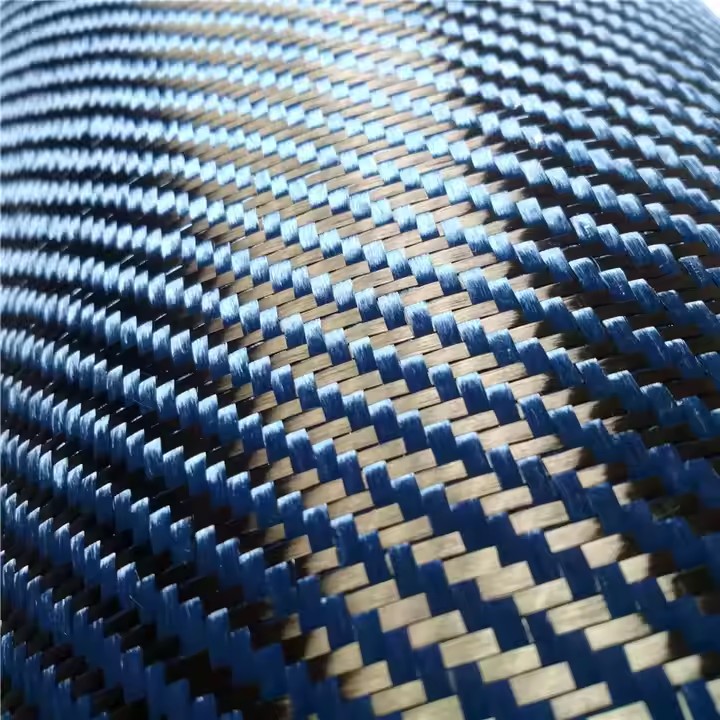
Carbon/Aramid Hybrid Fabric
Carbon fiber and Kevlar aramid interwoven in hybrid twill. Combines stiffness with impact resistance for demanding composite applications.
Carbon + Aramid
Hybrid Twill
¥20.0/m²
View Full Specs →
Application Decision Matrix: Which Fiber for Which Job
The answer to “which fiber should I buy?” depends on what the laminate needs to do. Below is a decision matrix organized by application, with the recommended fiber and the reasoning behind it.
| Application | Primary Demand | Best Fiber | Why |
|---|---|---|---|
| Aerospace structural panels | Stiffness + low weight | Carbon fiber | 230+ GPa modulus at 1.8 g/cm³, no viable alternative at that weight |
| Ballistic armor (vests, vehicle) | Impact absorption | Aramid or hybrid | Kevlar’s progressive failure mode absorbs impact energy; hybrid adds stiffness for structural panels |
| Automotive structural parts | Stiffness + moderate cost | Carbon fiber or hybrid | CF for primary structure, hybrid for impact zones (B-pillars, door panels) |
| Marine hulls (competition) | Stiffness + impact | Hybrid | Dock impact and wave loading require both modulus and energy absorption |
| Marine hulls (workboat) | Cost + corrosion resistance | E-glass | Weight not critical, cost dominant, glass fiber is corrosion-proof in saltwater |
| Pipes and tanks (chemical) | Chemical resistance + cost | E-glass | Non-reactive to most chemicals, lowest cost, weight acceptable |
| Wind turbine blades | Fatigue life + cost | E-glass (spar cap: carbon) | Most blade volume is E-glass; carbon fiber used only in spar caps for stiffness |
| Sports equipment (rackets, bikes) | Stiffness + weight + feel | Carbon fiber | Light weight and vibration damping; aramid used in some impact zones |
One pattern emerges clearly: E-glass dominates wherever cost and chemical resistance are the primary requirements and weight is secondary. Carbon fiber dominates wherever stiffness-to-weight ratio is critical. Aramid dominates wherever impact absorption is the primary demand. The hybrid fabric fills the gap where two of these requirements overlap.
How to Evaluate Supplier Claims (Without Getting Burned)
Every supplier claims their fiber meets specification. But “meets spec” can mean very different things depending on test protocol, sample size, and how failures are counted. Here is what procurement teams should verify before committing to a large order.
Supplier Audit Checklist
A supplier who can answer all six questions with specific, verifiable data is a supplier worth testing. A supplier who provides only marketing language (“high performance”, “premium grade”) without test data, traceability, or batch-level specificity is a risk. The difference becomes obvious when a production batch fails QC and you need to trace the cause back to the fiber source.
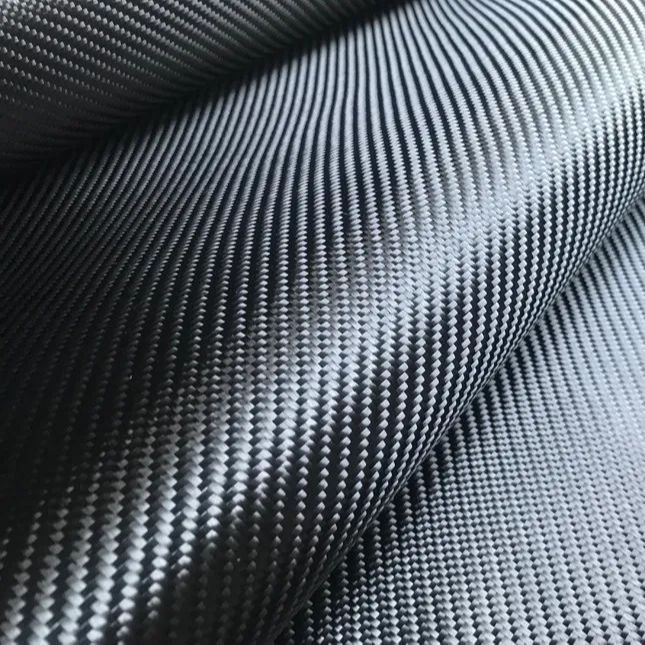
3K Carbon Fiber Fabric — Plain & Twill Weave (200 gsm)
Standard modulus 3K carbon fiber fabric for structural laminates. Full ASTM D3039 test data available. 30 m² MOQ, free samples, 30-day lead time.
3K Tow
200 gsm
Plain / Twill
View Full Specs →
FAQ
Is carbon fiber stronger than aramid?
Yes, in tensile strength. Standard modulus (SM) carbon fiber delivers 3.5 GPa tensile strength versus 3.0 GPa for Kevlar 49 aramid. However, aramid absorbs significantly more impact energy due to its progressive failure mechanism. “Stronger” depends on whether you mean tensile load capacity or impact survival.
What is the main difference between carbon fiber and glass fiber?
Density, stiffness, and cost. Carbon fiber is roughly 40% lighter (1.8 vs 2.54 g/cm³) and 3x stiffer (230 vs 73 GPa modulus) than E-glass. Carbon fiber costs 3-4x more per m². If weight and stiffness are not critical to your application, E-glass is the more economical choice.
When should you choose aramid over carbon fiber?
Choose aramid when your application requires impact absorption, abrasion resistance, or electrical insulation. Ballistic armor, protective racing gear, and blast-resistant panels all require aramid’s progressive failure behavior. If your application is purely stiffness-driven (structural panels, wing skins), carbon fiber is the correct choice.
Is carbon aramid hybrid fabric worth the cost?
Yes, when your laminate needs both stiffness and impact resistance. Hybrid fabric retains roughly 70% of carbon fiber’s modulus while gaining roughly 50% of aramid’s impact absorption. At ¥15-20/m², it costs less than pure aramid and performs better than pure carbon fiber in impact-loaded applications. For applications where only one property matters, use the pure fiber instead.
Key Takeaways
- Carbon fiber leads on tensile strength (3.5+ GPa) and modulus (230+ GPa) but fails brittle under impact.
- Aramid (Kevlar 49) sacrifices stiffness (112 GPa) for superior impact absorption and abrasion resistance.
- E-glass costs roughly one-third of carbon fiber per m² but carries 40% more weight and 3x less stiffness.
- Carbon/aramid hybrid fabric bridges the stiffness-impact gap at a price point between pure CF and pure aramid.
- Verify supplier claims with ASTM D3039 test data, fiber traceability, and batch-level specificity before committing to large orders.
Need a fiber comparison sample kit? Request a free sample → — We ship carbon fiber, aramid hybrid, and E-glass reference swatches within 3 business days.