


In this article:
- What Carbon Fiber Fabric Actually Is
- Key Properties That Matter for Buyers
- Tow Size: 1K, 3K, 6K, 12K — What the Numbers Mean
- Weave Types: Plain, Twill, Satin, and UD
- Areal Weight and Width: How to Choose the Right gsm
- Carbon Fiber Fabric vs Other Reinforcement Materials
- How to Evaluate a Carbon Fiber Fabric Supplier
- Frequently Asked Questions
Wondering what is carbon fiber fabric and how the spec sheets make sense? If you’re sourcing for the first time, those terms look like alphabet soup: 3K, 200 gsm, twill, UD, T700. Each one changes what you pay, what your laminate weighs, and how your finished part performs. Here’s what each term actually means for your purchase decision.
A procurement-focused breakdown of carbon fiber fabric: properties, weave types, tow sizes, and what to ask before you order.
What Carbon Fiber Fabric Actually Is
Carbon fiber fabric is a woven textile made from carbon fiber tows (bundles of 1,000 to 12,000 continuous filaments) arranged in plain, twill, satin, or unidirectional patterns. With a density of 1.75–1.80 g/cm³ and tensile strength of 3.5–7.0 GPa depending on fiber grade, it delivers approximately 5× the strength of steel at roughly ¼ the weight, making it the primary reinforcement material in high-performance composites.
The production chain starts with a precursor (either polyacrylonitrile (PAN) or petroleum pitch) that gets stretched, oxidized, and carbonized at temperatures above 1,000 °C. The resulting filaments are 5–10 micrometers in diameter, thinner than a human hair. These filaments are bundled into tows (the “K” number refers to how many thousands of filaments per tow), and then woven into fabric on conventional textile looms adapted for the stiffness of carbon fiber.
Two things set carbon fiber fabric apart from other reinforcement textiles. First, the 3K carbon fiber fabric range most buyers start with delivers a tensile modulus between 230–240 GPa (standard modulus, T300/T700 grade), while high-modulus grades push past 500 GPa, a difference that directly affects laminate stiffness. Second, the fiber-to-fabric conversion process introduces variability: pick count per centimeter, filament spread, and weaving tension all shift the final areal weight by 10–20 gsm even when the same tow is used.
Key Properties That Matter for Buyers
When you evaluate a carbon fiber fabric for a production order, these are the properties that shift your cost, your tooling, and your end-part quality, not the marketing specs on a supplier’s homepage.
| Property | Typical Range | What It Means for Your Order |
|---|---|---|
| Density | 1.75–1.80 g/cm³ | Laminate weight calculation baseline; 5× lighter than steel (7.85 g/cm³) |
| Tensile Strength | 3.5–7.0 GPa | Higher grade = stronger laminate, but price jumps 30–50% from standard to intermediate modulus |
| Tensile Modulus | 230–540+ GPa | 230 GPa (standard) vs 390 GPa (intermediate) vs 540+ GPa (high modulus) — stiffness vs cost trade-off |
| Elongation at Break | 1.5–2.0% | Lower elongation = more brittle laminate; affects crash-performance applications |
| Thermal Conductivity | 7–12 W/mK (in-plane) | Relevant for thermal management in electronics and battery enclosures |
| Carbon Content | 92–99% | Higher carbon content = higher modulus, but also higher processing cost |
| Filament Diameter | 5–7 µm (PAN-based) | Smaller diameter = better resin wetting; larger = cheaper precursor |
Per ASTM D3039, tensile testing for polymer matrix composite materials uses a straight-sided specimen with a specified width and gauge length. When a supplier sends you a test report, verify it references this standard — not an in-house method that can’t be cross-checked.
Tow Size: 1K, 3K, 6K, 12K — What the Numbers Mean
The “K” in 1K, 3K, 6K, 12K is the number of carbon filaments per tow. One tow = one bundle. A 3K tow contains 3,000 filaments; a 12K tow contains 12,000. This number affects three things: fabric weight (gsm), surface appearance, and price per square meter.
| Tow Size | Filament Count | Typical gsm Range | Price Indicator | Common Use |
|---|---|---|---|---|
| 1K | 1,000 | 80–120 gsm | Highest (low-volume, specialty) | Lightweight cosmetic panels, thin-walled aerospace structures |
| 3K | 3,000 | 150–240 gsm | Moderate (most popular) | General-purpose composites, automotive, sporting goods, UAVs |
| 6K | 6,000 | 200–350 gsm | Moderate-Low | Industrial laminates, larger structural parts, wind energy |
| 12K | 12,000 | 300–600+ gsm | Lowest per gsm (high-volume) | Thick laminates, civil infrastructure, cost-sensitive bulk applications |
The reason 3K dominates the market is simple: it balances fineness (thin enough for cosmetic surfacing layers) with cost efficiency (cheap enough for structural plies). According to Grand View Research (2025), the global carbon fiber market reached USD 3.16 billion, with standard-modulus PAN-based fiber (T700/3K grade) accounting for over 60% of total shipment volume.
Weave Types: Plain, Twill, Satin, and UD
The weave pattern determines three performance variables: stability (how much the fabric shifts during layup), drapability (how well it conforms to curved molds), and surface finish (what the cured laminate looks like under clear coat).
Plain weave alternates every filament over and under in a 1×1 pattern. This gives maximum stability: the fabric doesn’t shift on the tool, which makes hand layup predictable. The trade-off is poor drapability over complex geometries, and the visible checkerboard pattern can be a cosmetic concern for show-quality parts.
Twill weave uses a 2×2 or 2×1 pattern (two tows over, two under), producing the diagonal line pattern most people associate with “carbon fiber look.” It drapes better than plain, roughly 15–20% more conformable on compound curves, while retaining enough stability for vacuum bagging. For most buyers, twill is the default choice.
Satin weave (4H or 8H satin) extends the float length: a tow passes over 4 or 8 crossing tows before going under one. Maximum drapability, minimum crimp angle, and the smoothest surface finish. Used where appearance matters (visible automotive panels, aerospace interior trim) or where the mold has deep draws. The cost: satin fabrics are less stable during handling, and the long floats can snag.
Unidirectional (UD) isn’t woven at all. All filaments run in one direction, held together by a small amount of binding yarn or thermoplastic powder. UD delivers the highest mechanical properties in the fiber direction (0°) because there’s zero crimp, no strength lost to the weaving geometry. UD fabric is the structural backbone in load-bearing laminates, typically combined with woven layers for off-axis strength.
Areal Weight and Width: How to Choose the Right gsm
Areal weight (gsm = grams per square meter) tells you how much fiber you’re putting into each ply. It’s the number that directly calculates laminate thickness and weight.
The formula: laminate thickness per ply ≈ gsm / (density × 1000). For a 200 gsm, 3K twill at 1.78 g/cm³ density, one ply contributes approximately 0.11 mm of cured laminate thickness. A 6-ply layup = ~0.66 mm total. This calculation matters when your part has a thickness specification.
Width choices are less flexible. Standard carbon fiber fabric widths range from 50 mm (narrow tape) to 1,500 mm (full-width roll). The most common production widths are 1,000 mm and 1,270 mm. Narrow widths cost more per square meter due to additional trimming waste, but they’re necessary for filament winding, tape layup, and small-part production. If your mold is 800 mm wide, ordering 1,000 mm fabric and trimming 200 mm of waste per ply adds real cost over a production run.
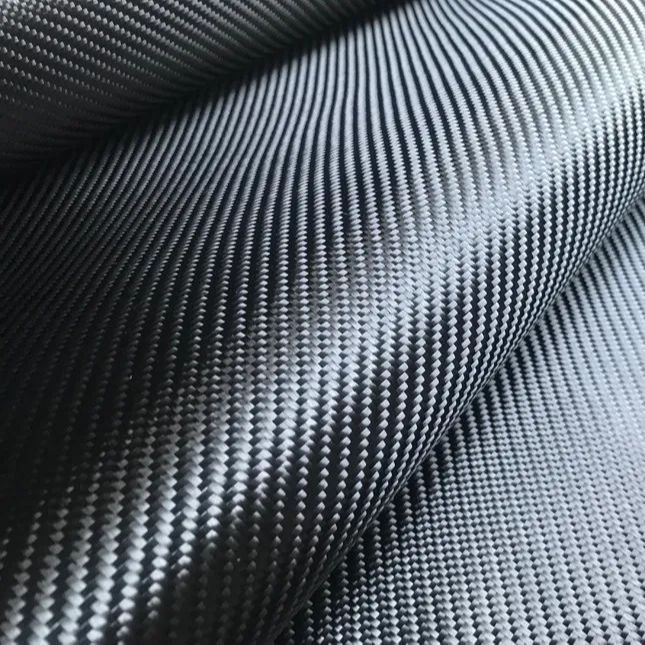
3K Carbon Fiber Fabric — Plain & Twill Weave (160–240 gsm)
Our most versatile carbon fiber fabric for general-purpose composite production. Available in plain, twill, and satin weave at 160, 200, and 240 gsm. Standard width 1,000 mm, custom widths available on request.
3K Tow
160–240 gsm
Plain / Twill / Satin
1000mm Width
View Full Specs →
Carbon Fiber Fabric vs Other Reinforcement Materials
Most composite applications choose between three reinforcement fiber families: carbon, aramid (Kevlar®), and glass (E-glass or S-glass). The decision comes down to what you need most: stiffness, impact resistance, or cost efficiency.
| Property | Carbon Fiber | Aramid Fiber | E-Glass Fiber |
|---|---|---|---|
| Density (g/cm³) | 1.75–1.80 | 1.44 | 2.54–2.60 |
| Tensile Strength (GPa) | 3.5–7.0 | 3.0–3.6 | 2.0–3.5 |
| Tensile Modulus (GPa) | 230–540+ | 70–130 | 70–85 |
| Elongation at Break (%) | 1.5–2.0 | 2.5–4.0 | 4.5–5.2 |
| Cost per kg (approx.) | $15–40+ | $20–50+ | $1–5 |
| Best For | Maximum stiffness-to-weight ratio | Impact resistance, ballistic, abrasion | Cost-sensitive, high-volume |
| Weakness | Brittle under impact; expensive | UV degradation; difficult to cut | Heavy; low modulus |
Carbon fiber wins when stiffness and weight are the priorities: aerospace primary structure, performance automotive, competitive sporting goods, drone frames. Aramid wins when impact energy absorption matters: ballistic protection, helmet shells, protective gloves. E-glass wins when cost drives the decision: marine hulls, civil infrastructure, bulk industrial containers.
There’s also a hybrid option: carbon/aramid fabric combines the stiffness of carbon with the impact toughness of aramid in a single woven layer. Per ScienceDirect’s review of carbon fibre for aerospace applications, hybrid fabrics can reduce delamination risk by 30–40% compared to all-carbon layups under impact conditions, which makes them a practical choice for crash zones in automotive and protective structures.
How to Evaluate a Carbon Fiber Fabric Supplier
Before you commit to a bulk order, these are the checks that separate a reliable supplier from one that will delay your production line.
- Request a test report referencing ASTM D3039 or ISO 13934-1 — not an in-house spec sheet
- Verify batch-to-batch areal weight consistency: ask for the last 5 batches’ gsm data and check the standard deviation
- Confirm MOQ aligns with your production cycle — our MOQ is 30 m² for standard grades, with free samples available for qualification
- Check lead time including shipping, not just production — our standard lead time is 30 days from order confirmation
- Ask for ISO 9001:2015 certification documentation, not just a logo on the website
- Order a sample before committing to a container load — test it in your own resin system and mold geometry
The single most revealing question to ask a supplier: “What was the gsm variance across your last 10 production batches?” If they can’t answer with a number, they don’t track it. And that means your laminate thickness will drift over a production run.
We hold ISO 9001:2015 certification and track pick count and areal weight on every batch. If a batch deviates more than ±5 gsm from the target, it gets flagged before shipping. This is the level of traceability your production schedule needs.
One more thing on resin compatibility. Carbon fiber fabric works with all three common composite resin systems, but the pairing matters for your final part. Epoxy gives the best mechanical properties (highest interlaminar shear strength, ~60–80 MPa) and is the default for aerospace and performance automotive. Polyester resin costs 40–50% less but sacrifices 15–20% of laminate strength; acceptable for marine hulls and decorative panels where strength margins are generous. Vinyl ester sits in the middle: better chemical resistance than polyester, closer to epoxy on mechanical properties, and often chosen for chemical tanks and industrial containers. The fabric itself doesn’t change between resin systems, but the fiber volume fraction you achieve in the cured laminate does. Epoxy wets carbon fiber more thoroughly, giving 60–65% fiber volume in a well-pressed layup, versus 50–55% with polyester. That 5–10% difference in fiber volume shifts laminate modulus by roughly 10–15%.
Frequently Asked Questions
Ready to qualify a fabric for your next production run? Browse our full carbon fiber fabric catalog or request a free sample. We ship within 5 business days and typically reply to inquiries within 24 hours.
About the Author
Impact Materials Engineering Team — Composite Materials R&D Division, with 20 years in carbon fiber and aramid composite fabric production, quality testing, and OEM specification development. Has overseen 500+ batches of 3K carbon fiber fabric across plain, twill, and satin weaves, with quality data tracked per batch for areal weight consistency and mechanical performance.